Hey Everyone,
I've been in a lot of AI conversations lately. With clients, on podcasts, at leadership tables. And the same thing keeps coming up: companies are moving fast on AI, but the results aren't matching the momentum.
Tools are deployed. Pilots are running. Budgets are committed. And yet, when you ask what it's actually done for the business, the answers get fuzzy.
That's what this issue is about. Not AI in the abstract, but AI done in a way that actually moves the needle. We're covering the strategic mistakes we see most often, how we're using AI to improve how we build software (including QA, which is one of the unglamorous places where a lot of time and money disappears), and the framework I shared on the Dynamics Corner podcast that I keep coming back to: start with your most expensive problem, not the tool.
If your organization is in the "we know we should be doing something with AI" phase, these three pieces should help you figure out what that something actually is.
Good stuff ahead.Matt StrippelhoffPartner, CEO/CRO - Red Hawk Technologies
Listen to our summary podcast that focuses on the highlights of Issue 11.
This issue looks at one idea from a few different angles:
That last point is important.
We’re not just talking about strategy. We’re seeing practical gains in areas like QA, where teams are improving speed and reliability at the same time.
By the end, you should have a clearer sense of where to focus and what matters most.
I joined the Dynamics Corner podcast recently and the question they asked me was simple: where should businesses start with AI?
My answer: take AI out of the conversation first.
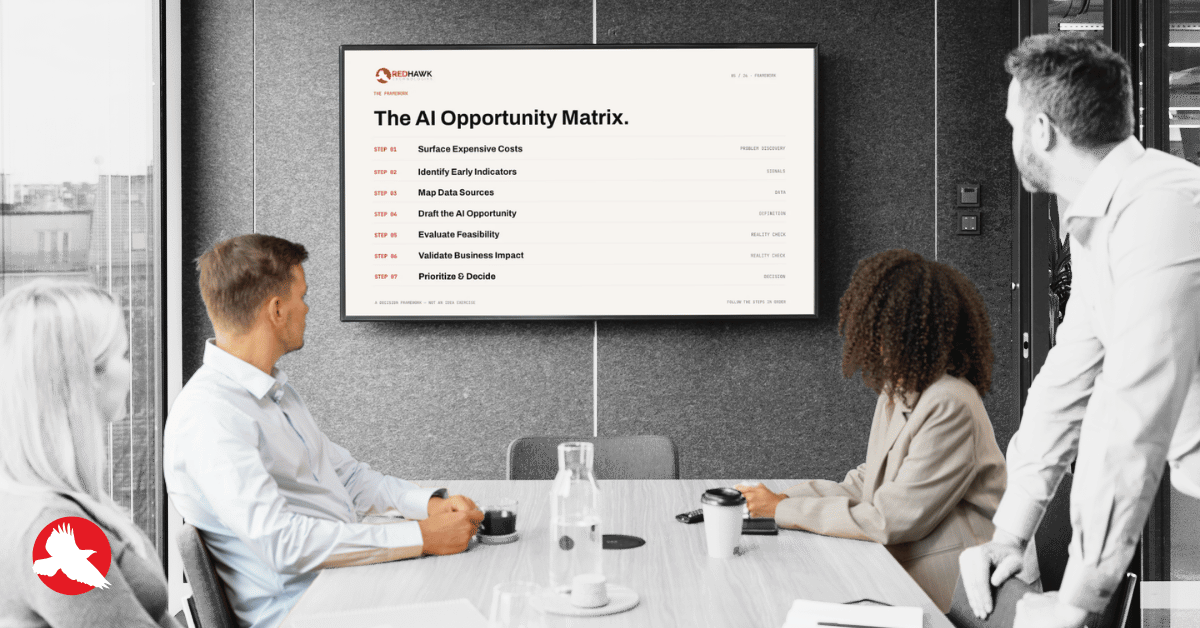
Before you evaluate a single tool, map your most critical workflow from end to end. Find the handoffs. Find the friction. Quantify what the status quo is actually costing you. Only then should AI enter the picture, as a potential solution to a specific, expensive problem you've already named.
This article captures that framework in full, including how to handle the shadow AI problem that most leadership teams know is happening but aren't talking about, and why the "14 agents and billions from the beach" version of AI success isn't how this actually works.
Ready to flip the script? Read the full blog for the complete framework and download our free AI Opportunity Decision Matrix to start mapping your own workflows today.
The companies getting real ROI from AI aren't starting with tools. They're starting with problems.

Most mid-market companies have moved from curiosity to action on AI. Pilots are running. Tools are in use. But measurable financial impact is still rare.
In this article, we break down the three strategic mistakes we're seeing most often, starting with tools before defining outcomes, skipping governance, and measuring activity instead of ROI. None of these are technical failures. They're sequencing failures. And they're fixable.
The piece also covers why a solid data foundation isn't optional: without it, AI doesn't create alignment. It exposes the lack of it.
AI creates leverage when it's tied to revenue, margin, or cost and when the data behind it can be trusted. Get the sequence right before you scale.
QA is often where timelines slip and pressure builds. It's one of those areas that's critical but easy to treat as an afterthought, right up until it costs you.
At Red Hawk, we've been rethinking how QA fits into the development lifecycle. This article covers what we're doing: using AI to accelerate test plan creation, build more consistent end-to-end testing, and integrate validation directly into CI/CD pipelines. The result is faster cycles, fewer surprises at release, and more confidence across the board.
Jason Wilson, our VP of Engineering, puts it well: getting QA right "goes a long way to increasing our reputation for reliability and takes the stress level down of releasing new versions."
When QA moves earlier and runs faster, the whole delivery process gets more predictable for the team and for clients.
These three pieces aren't separate topics. They're the same conversation.
Start with the Flip the Script framework. Before any tool, any platform, any budget conversation map your most expensive workflow and name the real problem. That's the foundation everything else builds on.
From there, the AI mistakes article picks up where that thinking leads. Once you know the problem you're solving, the next question is: are you set up to actually solve it? Most organizations aren't not because they lack ambition, but because they skipped the governance, started with the wrong metrics, or are trying to run AI on data that doesn't hold up. Those aren't technology problems. They're sequencing problems.
The QA article is what it looks like when you get the sequence right. A specific, expensive problem; testing takes too long, releases carry too much risk, met with a deliberate, measurable approach. Not AI for the sake of it. AI applied to something that matters.
That's the thread running through all of it.
Start with the problem. Build the foundation. Apply AI where it's earned.
That's how this actually works.
If AI is on your roadmap, the most important question isn’t which tool to use.
It’s whether your data is ready to support the decisions you expect AI to improve.
That’s where we help.
At Red Hawk Technologies, we work with teams to assess data readiness, define structure, and build foundations that support real outcomes.
At Red Hawk Technologies, we're not just building software; we're building partnerships that drive innovation. We understand the unique challenges mid-market companies face when it comes to custom web and mobile application development – the unpredictable costs, the ongoing maintenance headaches, and the complexities of managing long-term projects.
That's why we've revolutionized the industry with our Software Development-as-a-Service (SDaaS) solution. We bundle development, technical support, ongoing maintenance, and future enhancements into a single, predictable monthly fee. This game-changing model eliminates uncertainty, provides financial clarity, and ensures your software evolves with your business, allowing you to innovate with confidence and focus on what you do best.
We believe in a partnership that helps you realize the potential of digital transformation. We're an award-winning team with a proven process for on-time, on-budget delivery, focused on helping mid-market businesses like yours achieve significant returns. Our Software Development-as-a-Service (SDaaS) model ensures predictable costs and comprehensive support.
Whether you're exploring a new vision with our Tech Innovation Workshops, seeking robust custom development, or need ongoing support for existing applications, we're here to provide the expertise and predictable partnership you need.
Once you've sharpened your software vision, the next step is transforming that blueprint into a powerful, custom application. We're here to help you bring that idea to life with predictability and precision.
Take the next step: Book a consultation to discuss your custom software needs.
We hope you found this first issue insightful. Look out for our next edition, where we'll dive deeper into the strategies for success in custom software development.
Get the earliest access to hand-picked content weekly for free.